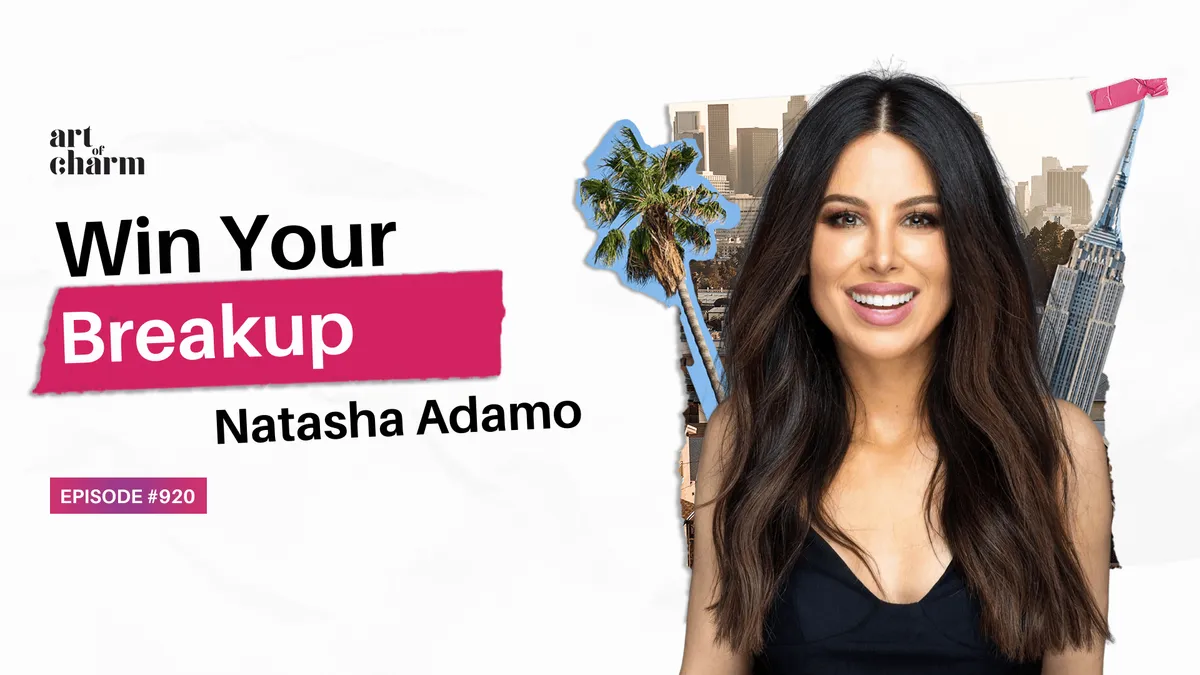
Natasha Adamo is a relationship coach and the author of Win Your Breakup: How To Be The One That Got Away. On The Art of Charm podcast she explains why the real win is losing someone toxic and growing from it. She covers spotting a toxic partner and why a healthy one may feel boring at first.
The full 50-minute episode is embedded on this page. Her book is written mostly for women, but as she says on the show, everyone deals with the same problems in different packaging. Below I’ve pulled out what matters most for men going through a breakup: the takeaways, a timestamped chapter list, and what I’d actually do this week.
Most dating advice tells you what to say. Very little helps you read the person in front of you. The Dating Influence Index is a 15-question quiz that scores five skills: “Notice the signals”, “Share the conversation”, “Choose the moment”, “Show clear interest” and “Make the next step clear”. It tests your judgment in dating situations, not how you compare with other people. Find my Dating Influence Index.
Who is Natasha Adamo?
Natasha Adamo describes herself as a relationship, self-help and high-performance coach, a #1 bestselling author, and a blogger (natashaadamo.com). Her book is Win Your Breakup: How To Be The One That Got Away. Her site says she coaches readers in more than thirty countries.
On the show she explains that the book grew out of her blog. She started it to answer every question she’d ever typed into Google at her lowest points after a breakup, because the answers she found were clickbait that repeated the same advice. Readers kept asking for a book. She didn’t want to staple blog posts together, so she wrote what she calls a dignified, Machiavellian playbook for breakups instead of “put down the ice cream and love yourself.”
Episode chapters
- 0:00 Why Adamo wrote Win Your Breakup
- 2:00 Toxic or just immature? Intent vs. incompetence
- 3:01 Her definition of toxic
- 4:01 Signs you’re in a toxic relationship
- 6:02 Love doesn’t blind you. Unhealed trauma does
- 7:02 How unprocessed damage turns into baggage
- 8:02 Don’t internalize other people’s behavior
- 9:03 What it really means to win a breakup
- 11:03 Taking responsibility for what you attracted
- 12:03 Like attracts like, and dating a “hologram” of a parent
- 17:05 Don’t run straight into the next relationship
- 18:05 Why a healthy partner might bore you at first
- 20:06 Limerence wears off. What’s left is real love
- 22:09 Triangulation: competing for time and attention
- 23:10 The moment you choose yourself
- 24:11 “Stay on your white horse”: respond, don’t react
- 25:12 The movie theater test
- 27:14 Take action toward your core values
- 28:15 Delete them? Why “killing off” old patterns works better
- 30:16 Why people resist change
- 33:20 Nobody treats you worse than you treat yourself
- 36:22 Stop worrying about whether your ex is changing
- 39:25 Why waiting for them to change is a fantasy
- 42:26 Becoming an “emotional entrepreneur”
- 44:27 Owning your past so nobody can use it against you
- 47:30 Adamo’s X-factor: she doesn’t outsource her empathy
How to tell if the relationship was toxic
Adamo’s definition is the most useful one I’ve heard: toxic is anyone who gets validation by exploiting your hunger for theirs. Consciously or not, the result is the same. It drains you.
Her signs are simple, and she says people over-complicate them so they can stay stuck:
- You keep questioning your own worth.
- You feel like you constantly have to try harder.
- You end up consoling your partner for what they did wrong to you.
- You feel more drained than uplifted.
She also flags triangulation. It’s never just the two of you. It’s you, them and their job, their family, their cause. Even if the other point of the triangle is something admirable, if you have to compete for basic relational necessities like time, attention, honesty and communication, that’s a clear warning sign.
Why do men stay past all that? We tell ourselves love is blind. Adamo flips it: love isn’t what blinds you. Real love, including love for yourself, makes you see clearly enough to leave. What keeps you there is unhealed damage from past relationships and a slowly draining self-esteem. Deep down, she says, your instincts know.
If you also want to sharpen how you communicate and lead at work, THEOS, the Elite Operators System is an eight-week live installation of eighteen metaskills.
What “winning your breakup” really means
People see the title and assume it’s about revenge. Adamo says the opposite. The real win is realizing you won by losing someone who was toxic to your mental health. You can’t lose a toxic person. You can only win everything that comes with their absence.
The core of the book is to make a detailed inventory of everything your partner did and how it made you feel, then use that recognition to get out of your own toxicity. That’s the part guys skip. If you only villainize your ex, you feel good for a few seconds and keep the same dysfunction.
Here’s where it gets uncomfortable. Adamo says like attracts like. She used to be drawn to selfish, narcissistic people. They’re fun, the life of the party, right up until you’re in a relationship with one. She realized that while they made everything about them, she was making their behavior all about how she wasn’t enough. Either way, it’s still about you.
She also says you may be dating a “hologram” of a parent or someone who hurt you in the past, repeating the pain because it’s familiar.
What I’d do with that:
- Write the inventory. What did she do, and how did it make you feel? Be specific.
- Write your half. What did you tolerate? Where did you go quiet? What drew you to her in the first place?
- Find the pattern. Look at your last two or three relationships. If the same type keeps showing up, that’s your work, not bad luck.
Rebuilding after a breakup often means rebuilding how you show up with people. If you’re curious how that work looks in practice, you can see how the X-Factor Accelerator approaches it.
Why the right person might feel boring
This was my favorite part of the conversation. Adamo says that if you’ve struggled with self-esteem and you meet someone healthy, available and secure, you probably won’t feel much attraction at first. You’ll call them boring or “too nice.”
That’s because you’ve spent years equating passion with inconsistency: hot and cold, yes and no, push and pull. Her line is that passion is not inconsistent and intimacy is the most consistent thing. When you finally get consistency, you don’t know what to do with it.
She’s not saying force attraction that isn’t there. She’s saying if your reaction is “she’s great but a little boring,” give it a chance. People become more attractive as you get to know them.
On our side, we added the idea of limerence: the rush of falling in love that dating culture treats as the standard. That rush wears off. What’s left is getting to know someone and falling into a deeper kind of love.
And before you look for the next person, look at yourself. Adamo’s warning: if you’re looking for someone to see in you what you can’t see in yourself, you won’t have a healthy relationship. The right people won’t be drawn to you, and the wrong ones will use you.
If your conversations feel pleasant and then go nowhere, you may be paying too much attention to the words. Conversation Radar teaches you to notice when someone lights up, opens a door, or pulls back, while you’re still there. Four modules, nine signal types, no scripts. Explore Conversation Radar.
Stay on your white horse
Adamo’s mom came up with this phrase. The knight on the white horse isn’t there to save anybody else. He’s you, staying above the drama. Adamo says the food toxic people feed on is your reactivity, so not reacting is a superpower. Responding is rooted in action. Reactivity is rooted in triggers.
You’ll slip. Everybody does. She says to use the embarrassment you feel to get back on.
Her gut check is a good one. Imagine your life is a movie and you’re in the audience. What are you rooting for the main character to do? Text her at 2 a.m.? Message the new guy she’s seeing? Of course not. You’d be throwing popcorn at the screen. The characters we love take action and get back up in ways nobody expected.
The first steps after a breakup
A guy’s first question is usually: do I delete her from social media? Throw out her stuff? Adamo isn’t against it, but she says focusing only on removal is like a restrictive diet. You’re fixated on what’s missing.
Instead, the first chapter of her book is about remembering who you are by deliberately killing off what no longer serves you: the people-pleasing, the insecurity, the habit of internalizing other people’s behavior. Her exercise is to write out everything you’re no longer willing to tolerate, from other people and from yourself, and use that list as fuel.
On our end, we pair that with a core values exercise. In a toxic relationship you drift from your values to win approval. After the breakup, every action should point back toward them.
Then stop worrying about whether your ex is changing. Adamo’s take: if your ex was toxic and jumped straight into something new, they haven’t done the work. What separates you from them is self-awareness. You want to get better.
Don’t take their behavior personally either. In her words, when she was toxic, she didn’t act badly to teach good people a lesson about their worth. She did it because she felt worthless. Their behavior says something about them, not you.
Become an emotional entrepreneur
Adamo’s closing idea is the emotional entrepreneur: someone who doesn’t need outside validation because they validate themselves. Everyone is drawn to that person. You can be compassionate and have hard limits at the same time. “That’s your opinion, and that’s fine, but it doesn’t dictate what I think I’m worth.”
How do you get there? Own everything you’ve done, without excuses. Explain why you did it, what you learned, and how it made you better. When you can do that, nobody can use your past against you.
Her X-factor fits: she doesn’t outsource her empathy. She doesn’t feel obligated to empathize with everyone, so she’s less likely to take other people’s behavior personally, and she can go deeper with the people who deserve it.
Her last line is the one to remember if you’re in the middle of it: this terrible point in your life could be the best thing that ever happened to you. Your ex can be your launching pad.
More from The Art of Charm