
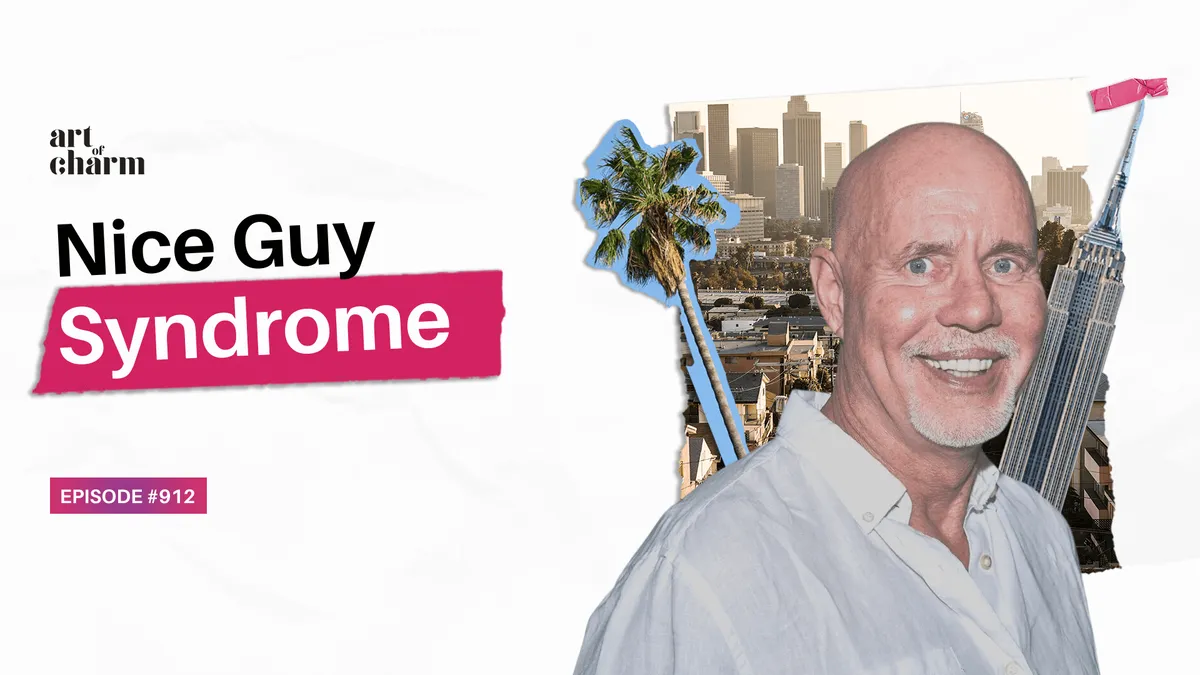
Guest: Dr. Robert Glover Author of No More Mr. Nice Guy and a recovering Nice Guy who has spent decades helping men break free of Nice Guy Syndrome.
Dr. Robert Glover wrote No More Mr. Nice Guy. On The Art of Charm podcast he explains Nice Guy Syndrome: the belief that you have to hide your needs and become what other people want. He breaks down the three covert contracts nice guys make, why being “nice” is a form of dishonesty, and how to rebuild your relationships.
The full 65-minute episode is embedded on this page. Below you’ll find Glover’s background, the key takeaways, a timestamped chapter list, and the moves I’d make this week if any of this sounds like you.
Most dating advice tells you what to say. Very little helps you read the person in front of you. The Dating Influence Index is a 15-question quiz that scores five skills: “Notice the signals”, “Share the conversation”, “Choose the moment”, “Show clear interest” and “Make the next step clear”. It tests your judgment in dating situations, not how you compare with other people. Find my Dating Influence Index.
Jump to
- Who is Dr. Robert Glover?
- Key takeaways from the Robert Glover podcast
- Episode chapters
- What Nice Guy Syndrome actually is
- “But what’s wrong with being nice?”
- The three covert contracts, and how to break them
- The three-page exercise that fills your bucket
- Boundaries without the blow-up
- Sexual shame and safe people
- More from The Art of Charm
- What next
- Frequently asked questions
Who is Dr. Robert Glover?
Dr. Robert Glover is the author of No More Mr. Nice Guy. His website says the book has sold over 2 million copies worldwide and has been translated into more than 20 languages. He describes himself as a recovering Nice Guy with more than 45 years of experience helping men get and keep the relationships they want. He runs workshops, coaching and an online community called Integration Nation (drglover.com).
In the episode he tells us he’s a therapist with a PhD. He’s been teaching an online class for about 20 years that Barnes & Noble had him develop when the book first came out, called “Nice Guys Don’t Finish Last, They Rot in Middle Management.” He lives in Puerto Vallarta, Mexico, and runs weekend workshops from his home. He also mentions that our dating podcast was one of the first podcasts he listened to while he was learning to date. That was a fun thing to hear from the guy who wrote the book we still recommend.
Key takeaways from the Robert Glover podcast
- Nice Guy Syndrome starts early. As kids, nice guys learned “there’s something wrong with me,” so they hide whatever gets a negative reaction: their wants, their needs, their sexuality.
- Nice isn’t the same as good. Glover’s sharpest point is that nice guys are inauthentic, and that means they aren’t honest.
- The alternative isn’t being a jerk. Black-and-white thinking keeps men stuck. There’s a lot of room between people-pleaser and jerk.
- Watch for covert contracts. “If I’m a good guy, I’ll be liked and loved.” “If I meet your needs without being asked, you’ll meet mine.” “If I do everything right, life will be smooth.” All three are hidden deals the other person never agreed to.
- Resentment is the tell. If you feel unappreciated, or like you’re giving more than you get, you’re probably running a covert contract.
- Rebuild your support system on paper. Glover’s three-page exercise maps the relationships that fill you up, the ones you need, and the ones you need to fix or cut.
- Shame heals in the open. Find safe people (a coach, a therapist, a men’s group) and say the things you’ve never said.
Episode chapters
- 0:00 Dr. Glover returns: why passive communication still holds men back
- 1:00 What Nice Guy Syndrome is, and how Glover became a nice guy
- 3:02 “Nice guy seduction” and the wake-up call from his second wife
- 4:03 Where it starts: childhood messages that “something is wrong with me”
- 7:03 “What’s wrong with being nice?” and the black-and-white thinking trap
- 9:04 Why nice guys are dishonest without realizing it
- 11:07 Nice guys at work: good at being good, not great at being great
- 14:10 Teflon men: people connect around rough edges
- 16:11 “You don’t have to listen”: the therapy story that changed his marriage
- 20:15 Covert contracts explained
- 21:15 Contract 1: if I’m a good guy, I’ll be liked and loved
- 22:16 Contract 2: if I meet your needs, you’ll read my mind
- 25:18 Contract 3: if I do everything right, life will be smooth
- 30:21 Why covert contracts shrink your social life
- 32:23 The cooperative reciprocal relationships (CRR) exercise, page one
- 40:27 Page two: the relationships you need to add
- 42:27 Page three: the relationships to renegotiate or cut
- 44:30 Conflict avoidance and setting boundaries
- 45:32 Glover’s boundary with his own family
- 49:33 Turning a recurring fight into teamwork with your partner
- 56:37 Sexual shame and how nice guys hide desire
- 1:00:40 Why you need safe people to reveal yourself to
- 1:03:41 Glover’s X-factor and where to find his work
What Nice Guy Syndrome actually is
Glover’s own story is the cleanest definition. He grew up trying to be the opposite of his father, who was moody, demanding and critical. His mom told him she was raising her sons to be different from their dad. So he decided to be the good guy, figuring women would like him for it.
Here’s how it played out with women. He’d watch a girl from across the room, try to sit near her in class, answer every question to show how smart he was, and maybe one day work up to: “I don’t guess you’d want to go out with me sometime, would you?” That’s about as indirect as it gets.
Years later, in his early 30s and in his second marriage, his wife told him to get help. Everybody thought he was a nice guy, but at home he was passive-aggressive, hurtful, and stored up resentments until he exploded.
Underneath all of it, Glover says, is one core belief: I’m not good enough as I am. To get my needs met, I have to become what other people want and hide whatever might get a negative reaction. For most nice guys, what gets hidden is exactly what makes them attractive: what they want, what they need, and their sexuality.
Nice Guy habits show up at work too, in how you ask for what you need and hold a boundary. THEOS, the Elite Operators System is an eight-week live installation of eighteen metaskills for that side of your life.
“But what’s wrong with being nice?”
Every time we cover this topic, somebody gets angry. “So I’m supposed to be a jerk?” Glover’s answer: why would anyone write a book teaching men to be mean? There are already plenty of mean men.
The trap is black-and-white thinking. If I’m not the pleasing, conflict-avoiding nice guy, the only alternative must be the jerk women complain about. Not true. The goal is to be an honest man with wants and needs who says them out loud.
That’s where Glover lands his punch. Nice guys think of themselves as honest because they don’t tell lies. But do you tell people what you really think, feel and want? Are you the same guy with every group, or do you check which way the wind is blowing? If you’re a chameleon, you’re not honest.
From the outside, that dishonesty kills trust. People watch you get walked on with a fake smile and conclude they can’t rely on you. Glover calls nice guys “Teflon”: nothing sticks to them, so nobody can connect with them. People bond over rough edges and real problems, not a polished front.
Nice guys hide what they want, so people have nothing real to trust. Saying plainly what you want is the skill that ends the hiding. It is a skill you can practice with a coach in the X-Factor Accelerator: 90 days, $1,499.
The three covert contracts, and how to break them
This is the part of No More Mr. Nice Guy that hits readers hardest, and Glover walks through all three.
1. “If I’m a good guy, I will be liked and loved.” For men, that usually includes “and the women I want will want to sleep with me.” The flaws: nobody is all good, and nobody is liked by everyone. Glover adds that what he calls nice guy seduction is the worst possible way to get there. Giving with strings attached is manipulation.
2. “If I meet your needs without you having to ask, you’ll meet mine without me having to ask.” You’re reading her mind, giving what you think she wants, and keeping score. She has no idea the deal exists. Glover adds that nice guys often pick a “fixer-upper,” someone who isn’t in a position to give much back. And because nice guys feel bad for having needs at all, they’re terrible at receiving even when someone does try to give.
3. “If I do everything right, I’ll have a smooth, problem-free life.” That one is a deal with the universe. Glover says life can be good, but it’s never smooth. The difficulties are how you grow.
How do you tell generosity from a covert contract? Glover’s test is simple: resentment. If you feel unappreciated, used, or like you’re giving more than you get, there’s a hidden deal in there.
Here’s what I’d do with that this week:
- Say the want out loud. Replace “I’ll take her somewhere nice and she’ll see I’m a good guy” with “I’d like to take you out Thursday.” Clear interest, no hidden invoice.
- Ask instead of hinting. Glover says one of the biggest changes he made was learning to just ask: “Hey, can you do this?” If they can’t, find another way.
- Stop rehearsing. He used to replay arguments in his head for months without ever saying “this is bothering me, can we talk about it?” If it’s been bugging you for more than a week, bring it up.
- Get more options. One covert contract with one woman can eat months of your life. Meet more people. You’ll need less from any one of them.
If your conversations feel pleasant and then go nowhere, you may be paying too much attention to the words. Conversation Radar teaches you to notice when someone lights up, opens a door, or pulls back, while you’re still there. Four modules, nine signal types, no scripts. Explore Conversation Radar.
The three-page exercise that fills your bucket
Glover credits this exercise with much of his own success, in business and in life. He calls it cooperative reciprocal relationships, or CRRs: relationships both sides choose to be in and both sides get value from.
Grab a big sheet of paper. Draw a stick figure of yourself with a bucket. That bucket has to get filled regularly for you to be energized, optimistic and attractive. Then:
- Page one: what fills your bucket now. Draw a circle for each person: friends, family, partner. Add professionals like your trainer, dentist and accountant, plus practices like the gym, meditation, walking your dog, and play. Give everyone their own circle so you notice the great friend you haven’t called in six months. When a workshop guy asked how many circles to aim for, Glover told him to shoot for a hundred.
- Page two: what’s missing. Glover once did this himself and wrote down a men’s group, a new accountant and a financial advisor. All three showed up within months.
- Page three: what isn’t working. The college buddy who’s still partying, the family member who drains you, the business partner it’s been off with. Either have the conversation and renegotiate, or cut it and make room.
His summary: once you do it, you start thinking “I’m responsible for my needs.” The bucket fills up, and a full bucket is attractive in a way a needy one never is.
On our side of the mic, here’s what we add: the more you build page one, the easier the page-three conversations get. When you have a full life, more options and new friends, you’re not negotiating from scarcity. You can set the boundary because you’re no longer afraid of losing the relationship.
Boundaries without the blow-up
Nice guys avoid conflict, so when they finally set a boundary it usually comes out badly. Glover’s own example was big. For years his mother complained to him about his father, and when he finally put a limit on it, things got so tense he didn’t speak to his parents for 15 years. Before his father died, he reached out and they reconnected. He and his mother worked it out at the hospital, and they have a loving relationship with boundaries today.
His point isn’t that you need to go silent for 15 years. It’s that the hard conversation is the price of a real relationship.
He also shares a newer approach with his wife. Instead of defending himself over and over against a recurring fear, he asked her: can we work on this together? Defending yourself with facts doesn’t change a deep emotional fear. Making it a team problem does. If you’re in a relationship that keeps having the same fight, try that framing.
Sexual shame and safe people
Glover’s last big topic is sex. He says almost everyone’s earliest sexual experiences came wrapped in secrecy and shame, and that doesn’t disappear when you grow up. For nice guys it often shows up as hiding desire.
His prescription: don’t try to fix it alone. Find safe people, whether that’s a therapist, a coach or a men’s group, and reveal what you’ve never told anyone. You’ll find out you’re not alone, and you’ll get accurate feedback that a lot of what you’ve been ashamed of is normal. When you stop repressing that energy, he says, it becomes part of you, and that’s attractive.
More from The Art of Charm
- How to say no and still be the nice guy
- Nice guys finish first if they do this
- Natasha Adamo on how to win your breakup
- Evan Marc Katz on dating well (episode 744)
- Dr. Stan Beecham on building belief systems
- How to cut toxic people out of your life
- All Art of Charm podcast episodes
What next
Frequently asked questions
Who is Dr. Robert Glover?
He's the author of No More Mr. Nice Guy and a self-described recovering Nice Guy. His site says he has 45+ years of experience helping men with relationships. In this episode he says he's a therapist with a PhD and lives in Puerto Vallarta, Mexico.
What is Nice Guy Syndrome?
In Glover's words, it's what happens when someone internalizes early in life that something is wrong with them, then tries to become what others want while hiding anything that might get a negative reaction, especially their wants, needs and sexuality.
What are the three covert contracts?
If I'm a good guy, I'll be liked and loved. If I meet your needs without being asked, you'll meet mine. If I do everything right, life will be smooth and problem-free.
What is Dr. Robert Glover's website?
He gives it on the episode as drglover.com. It has his classes, workshops and books.
Is No More Mr. Nice Guy about being a jerk?
No. Glover says that's black-and-white thinking. The book is about being honest and direct with your wants and needs, not about being mean.
How do I know if I have a covert contract?
Glover's sign is resentment: feeling unappreciated, used, or like you're giving more than you get.
Read next
More Social confidence articles- Art of Personal Development
How to Network When You Hate Networking
If you hate networking, pick two people to meet, ask about their work, and follow up with something useful within 48 hours. - Art of Personal Development
Why Do I Never Get Invited to Anything? 6 Real Reasons
Why do I never get invited to anything? Six common reasons, a self-check, a 4-week plan and scripts to get included without begging. - Art of Personal Development
Liked but Not Respected: Why It Happens and the Fix
Liked but not respected? See the signs, the causes (people-pleasing, weak boundaries, no follow-through) and the fixes that earn respect. - Art of Personal Development
Why Do I Feel Invisible to People? A Guide for Men
Why do I feel invisible to people? Common causes like people-pleasing and staying small, plus practical steps to be seen and remembered. - Art of Personal Development
Chris Hadnagy Podcast: Build Trust With Social Engineering
Social engineer Christopher Hadnagy on the Art of Charm podcast: the four questions strangers ask, pretexting for real life, and why compliments backfire. - Executive presence
Executive Presence: What It Really Means and How to Develop It
Executive presence is how people read you when you're being watched. What it means, why strengths can undermine it, and how to develop it with self-awareness.