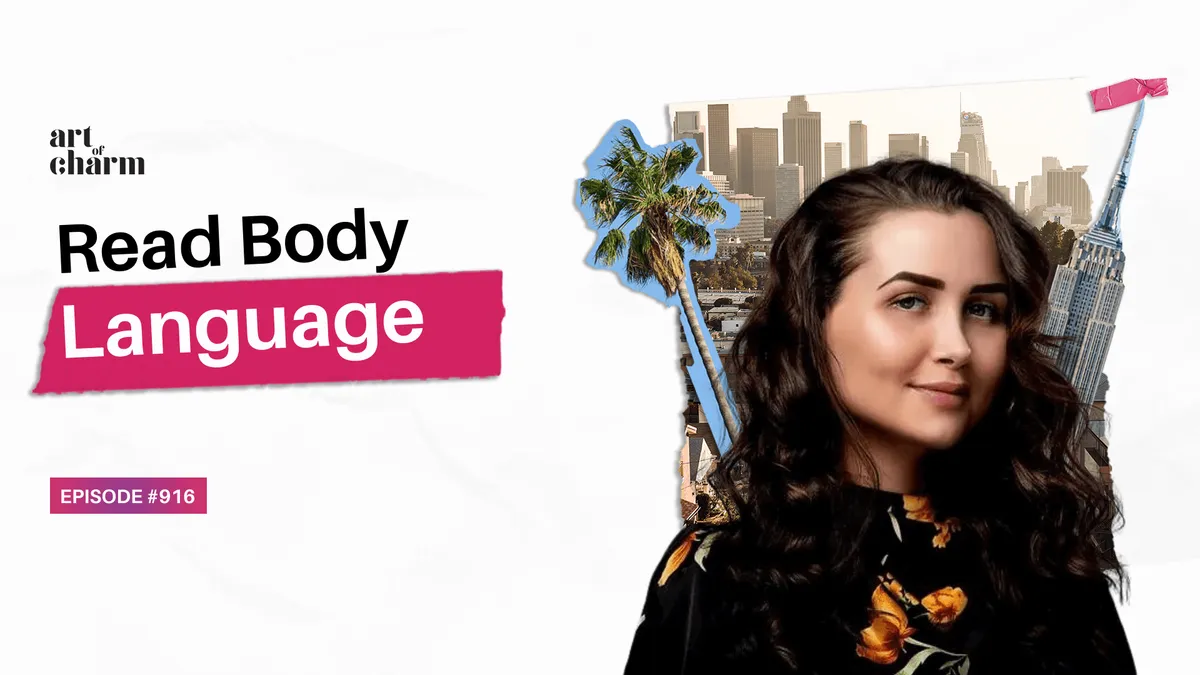
Dr. Abbie Maroño is a behavioral scientist who specializes in trust and nonverbal communication. On The Art of Charm podcast she explains that trust really comes down to safety, and walks through the body language that builds it: genuine smiles, open palms, and where your feet point. She also explains why a cheap apology makes things worse.
The full 48-minute episode is embedded on this page. Below you’ll find her background, the key takeaways, a timestamped chapter list, and the specific changes I’d make to your body language starting today.
Maroño’s research says people judge you on trust before anything else. Want to know how you come across? The Influence Index is a 15-question quiz that scores five skills: Read the signals, Read the room, Choose the moment, Make it clear, and Follow through. Find out what helps you connect, get heard, and win support for your ideas. Find my Influence Index.
Who is Dr. Abbie Maroño?
Dr. Abbie Maroño is a behavioral scientist and keynote speaker specializing in trust, influence and nonverbal communication. Her site says she earned a PhD in Psychology, became a university professor at 23, was recognized by the U.S. Department of State for extraordinary ability in behavioral science, and has trained personnel from 29 U.S. federal agencies. She created a training program called The Upper Hand and is a TEDx speaker (abbiemarono.com).
She came to us through our friend Joe Navarro, who recommended her. In the episode she explains that she started out studying lie detection, like almost everyone who gets into nonverbal communication, and wrote two research papers looking for deception cues. What she kept finding was stress and discomfort, not lying. For her PhD she switched to cooperation and unconscious mimicry: how people create an environment where others feel safe enough to open up.
How you come across in a meeting decides how much trust you get at work. For the work and leadership side, THEOS, the Elite Operators System is an eight-week live installation of 18 metaskills.
Key takeaways from the Abbie Maroño podcast
- Trust is safety. If someone’s brain decides you’re not a threat and they can be vulnerable without being exploited, they trust you.
- Trust isn’t a toolkit. You can’t smile at the start of a conversation and then drop it. Consistency is what makes people feel safe.
- Humans are wired to cooperate. Reputation and gossip are how we’ve always figured out who to trust.
- Signal openness. A genuine smile, a slight head tilt, open palms, and facing the person all read as trustworthy.
- Your feet matter. In her study, foot direction alone changed whether someone seemed approachable.
- Read clusters in context. One crossed arm means nothing. Several closing gestures together, in context, might.
- Apologies have to cost you something. A quick “sorry” can lower trust more than saying nothing.
Episode chapters
- 0:00 How Maroño got into body language
- 1:01 There’s no single cue for lying
- 2:01 From deception to cooperation
- 3:01 What trust is: safety
- 4:01 Trust is built fast, and lost fast
- 5:02 You can’t rush trust, but you can remove the hurdles
- 6:04 Trust isn’t a toolkit: why consistency matters
- 8:05 Why we evolved to cooperate
- 10:05 Gossip, reviews and reputation
- 11:06 Treat the janitor like the executive
- 14:07 The genuine smile as a social signal
- 15:09 The head tilt and the exposed neck
- 16:10 Open palms, and why half-truths feel untrustworthy
- 17:11 Seeing your own smile on video
- 18:11 Emotional contagion and unconscious mimicry
- 19:11 The body language myths to ignore
- 21:13 Trying too hard to look safe
- 22:14 Building trust on video calls
- 25:18 Control your frame: light, background and camera
- 27:19 Her study on feet and approachability
- 29:22 The sequence of discomfort signals
- 31:23 Context, clusters and pacifiers
- 33:24 Rebuilding trust: the apology has to match
- 35:24 A real apology costs you something
- 36:24 Where to start: education, then practice
- 39:28 Eye contact myths and the three gaze zones
- 42:30 The eye-direction myth
- 43:31 How she changed her own body language
- 45:32 Record yourself and use the cringe
- 47:33 Her X-factor and where to find her
Maroño says scientists have split trust into cognitive, affective, behavioral and more, and over-complicated it. Her definition is simple: trust is safety. If my brain decides you’re not a threat and I can be vulnerable without you exploiting it, I trust you.
She says that judgment happens almost instantly, before we judge confidence or competence. It can also vanish instantly. One off note and the brain says “not safe.”
The mistake most guys make is treating trust as a set of techniques: smile, open posture, done. Maroño says it doesn’t work that way. If you use the behaviors at the start and drop them later, people stop seeing you as trustworthy. What makes people feel safe is consistency. Inconsistent people are unpredictable, and unpredictable people don’t feel safe.
From our side, we add a coaching point. You can’t speed up someone else’s trust, but you can remove whatever is getting in the way. Most people think building trust means adding steps. Usually it means taking things away: the nervous habits, the closed posture, the hot-and-cold behavior.
Why reputation is everything
Maroño argues that “dog-eat-dog” gets evolution wrong. Survival of the fittest is about which traits help the group thrive, and cooperation and trust are those traits. We evolved to cooperate.
We also evolved to gossip, because gossip tells the group who isn’t cooperating. We still do it. You check restaurant reviews. You ask a mutual friend what a new date is really like.
That’s why we teach clients to treat the janitor exactly the way they treat the executive. Your reputation travels ahead of you. If you only turn on the charm for people you think are high value, people notice, and they talk.
The body language that signals trust
Here’s Maroño’s short list, with how I’d use each one.
A genuine smile. She says a smile is a social signal. Bowlers often don’t smile when they hit a strike, only when they turn to face their friends. A real smile reaches the upper cheeks and eyes, and she says it calms the other person’s threat response.
This one matters for a lot of guys. We use video work in our classes, and one of the most common surprises is the smile. Internally they feel like they’re smiling all the time. On video, they look tense. As I put it on the show, you might be thinking “AJ, I’m definitely smiling,” but the camera doesn’t lie.
The head tilt. People instinctively protect the throat when they’re scared or hear bad news. A slight head tilt exposes the neck and says “I’m not worried you’re a threat.” She notes Darwin wrote about the same behavior in dogs.
Open palms and facing the person. Visible hands say you’re not hiding anything. Hands behind your back make the brain wonder why. She ties this to communication too: when people hold back information or tell half-truths, our brains fill the gap with the worst possibility.
Emotional contagion. Her PhD was on unconscious mimicry. We mirror each other and pick up each other’s emotions without trying. Show up excited and people get energized. Show up flat and you drain them.
That’s why she pushes back on a claim she saw that showing anxiety makes you seem more trustworthy. If you show anxiety, the other person catches it.
From our coaching side, we see the opposite mistake all the time. Nervous guys try so hard to look harmless that they shrink: hands behind the back, shoulders in, body small. It reads as uncomfortable, and the other person gets uncomfortable and leaves. Take up a normal amount of space, palms visible, face her, smile.
Your feet are giving you away
This is one of the most interesting parts of the episode. Maroño says people control their face, hands and upper body when they’re nervous, but forget about their feet. So she ran a study. Targets faced an observer with their upper body while their lower body pointed either toward the observer or away.
When the lower body faced the observer, the target was seen as approachable. When it pointed away, they weren’t. She says the sex of the target and the observer didn’t matter, and neither did how introverted or extroverted the observer was. The only thing that mattered was the foot orientation.
The practical move is simple. When you’re talking to someone you want to connect with, point your feet at them. If you’re half-turned toward the door, they’ll feel it.
If your conversations feel pleasant and then go nowhere, you may be paying too much attention to the words. Conversation Radar teaches you to notice when someone lights up, opens a door, or pulls back, while you’re still there. Four modules, nine signal types, no scripts. Explore Conversation Radar.
Stop “reading” single gestures
Maroño is blunt about the junk in her field. Crossed arms don’t automatically mean someone is hiding something. Looking away doesn’t mean lying. If you treat one gesture as proof, you’ll start treating the person as defensive, and they’ll become defensive.
In another study, she looked at how people’s lower bodies react when an interviewer makes them uncomfortable. What signaled discomfort wasn’t one gesture. It was a sequence: knees coming together, feet tucking under the chair, legs closing. Some gestures we associate with discomfort, like crossed arms, showed up in comfortable and uncomfortable people alike, because an interview is a little stressful no matter what.
Two lessons for your social life:
- Look for clusters, not single tells. Is most of her body language saying “comfortable,” or is it all closing up?
- Know about pacifiers. Everyone has a self-soothing habit like touching their face, jiggling a foot or playing with a pen. One pacifier with everything else relaxed probably has nothing to do with you.
Our take: spend less energy decoding and more energy on what you’re sending. Your signals shape how she responds, because she’s mirroring you.
Maroño says the “people who look away are lying” idea is a myth. People look away all the time, comfortable or not. And the claim that the direction someone looks reveals lying or creative thinking? She says there’s no science behind it.
Her practical framework for where to look:
- Business gaze: a triangle from the eyes to the nose.
- Social gaze: eyes down to the mouth.
- Intimate gaze: eyes down to the chest. Not for business settings.
As for how much: there’s no perfect amount. Give regular eye contact, don’t stare, and watch whether the other person seems uncomfortable. If they do, glance at other things and come back. If you’re chanting “eye contact, eye contact” in your head, you’ll miss the signals that matter.
How to rebuild trust after you blow it
This is one of the most useful parts of the episode. Maroño says you can rebuild trust, but the repair has to match what broke it. If you embarrassed a friend in public, a private “I’m really sorry” in your office won’t cut it. The apology has to make you as vulnerable as you made them.
And a throwaway “sorry, my bad” isn’t better than nothing. She says it can lower trust even further. A real apology costs you something. That cost is what tells the other person you value the relationship.
That applies everywhere: the girlfriend you snapped at, the buddy you flaked on, the coworker you threw under the bus. Match the repair to the damage.
Make it a habit, and use the camera
Maroño says she wasn’t a touchy-feely person, and closed body language came naturally to her. Because she knew open gestures and touch make people feel safe, she practiced until they felt natural. Her advice: learn to get comfortable with the stuff that makes other people feel safe. It feels forced at first. One day you realize you don’t think about it anymore.
She recommends recording yourself and reviewing it, cringe and all. We’ve found the same thing in our video work: the cringe is what drives the change. Seeing yourself through someone else’s eyes makes you want to fix it in a way no amount of coaching does.
Her X-factor: she keeps going no matter how many times she fails. She had lots of failed studies and rejections before her PhD.
More from The Art of Charm