Using techniques developed by the Marines makes reading nonverbal cues to identify potential threats very straightforward.
“Somewhere between 60-90 percent of all communication is nonverbal. If you’re making a decision in the absence of 60-90 percent of everything you could gather about a situation or person, are you really making an informed judgment?” -Patrick Van Horne
The Cheat Sheet:
- Can you determine threats by reading nonverbal cues?
- Discover how to observe people and situations with the Baseline + Anomaly = Decision process.
- Learn the four pillars of observable behavior and specifically the four ways to observe and assess individual people.
- Know how to assign a person to the dominant, submissive, uncomfortable, and comfortable clusters.
- Further master the process and trust your gut instincts about potential threats.
- And so much more…
It doesn’t matter if you’re in the military, on the police force, or just an average citizen walking the sidewalks of Anytown, USA; knowing how to accurately size up potentially threatening behavior in others before trouble strikes makes you and the people around you safer.
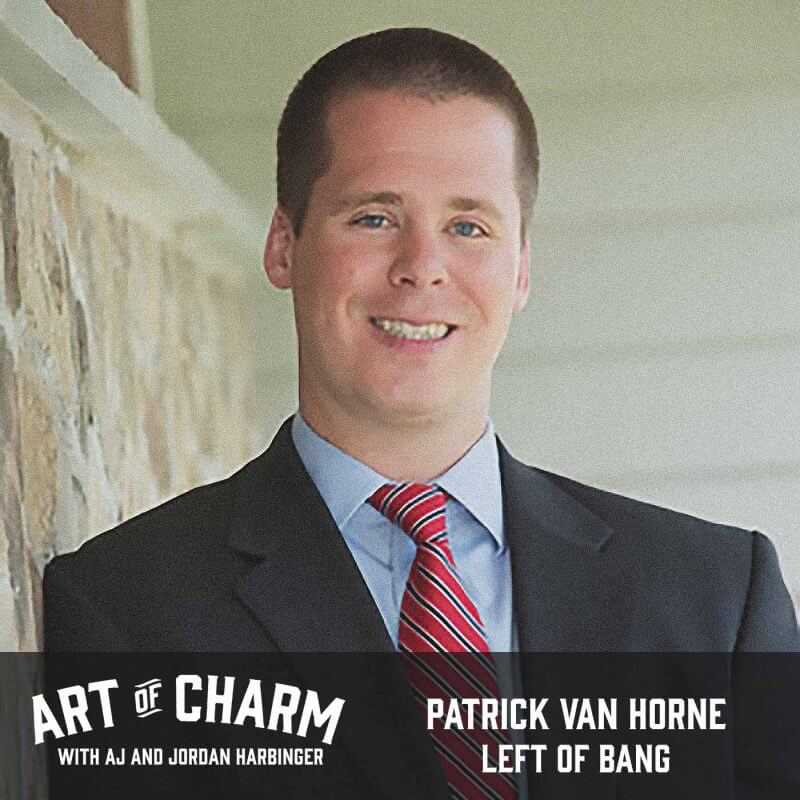
In episode 432 of The Art of Charm, we talk to Patrick Van Horne, a former Marine captain, co-author of Left of Bang: How the Marine Corps’ Combat Hunter Program Can Save Your Life, and CEO of CP Journal about how to use what he learned in his seven years of service to unmistakably identify people and situations that pose a threat to us and our loved ones by reading their nonverbal cues.
Ever wonder what your own body language says before you open your mouth? See what X Factor is about.
More About This Show
Prior to 2007, the US military’s strategy for dealing with insurgents in Afghanistan and Iraq was mainly reactive. The opposition had learned that the way to overcome the technological advantage of American forces was to get rid of their uniforms and blend in with the civilian population. If they could avoid detection, they reasoned, they could choose the time and place of their attacks and triumph with the element of surprise.
And it worked. For years, American Marines and soldiers could only prepare for the inevitable IED (improvised explosive device) detonations and ambushes by patrolling in greater numbers and equipping their vehicles and bodies with more armor; their goal simply became surviving an initial hit so they’d be capable of responding once the insurgents had given away their position.
It became clear to anyone paying attention that the chance for long-term success depended on tactics that went beyond waiting around to get shot at. In 2007, Marine Corps Gen. James Mattis initiated what would become the Combat Hunter program, and the basis for what Patrick Van Horne and his team now teach the general public. The idea was to switch from a strategy of reaction to proactive prevention by reading the intentions of potential troublemakers through nonverbal cues and disarming volatile scenarios before they erupted, and this is where the term “left of bang” originates.
What Does “Left of Bang” Mean?
Before the Combat Hunter program, the US military was operating with a “right of bang” mindset — that is, often quite literally, an explosive event (the bang) would happen, and the Americans would react to it. “When you are left of bang, it means that you’ve put bang onto a timeline,” says Patrick, “and you are operating earlier than [that] bang on the timeline…the goal is prevention. How can we keep it from ever happening?”
This is where we get into the four pillars of observable behavior: how we assess the environment, how we assess the collective, how we assess groups, and how we assess individuals.
Instead of giving us a hypothetical wartime scenario as an example, Patrick lays out a situation that’s at least somewhat familiar to anyone in modern America: walking into a Starbucks.
Baseline + Anomaly = Decision
First, you want to establish the baseline. What’s considered “normal” for the environment you’re entering?
When you walk through the front door of a Starbucks, one of the first things you intuitively observe is the noise level. Is it confrontational or conversational? Then you move on to visual cues. Is the place clean or dirty? Is it orderly or disorderly? Under normal circumstances, you can generally count on the noise level in a Starbucks being conversational, and the customer area is usually clean and orderly. The area has a sense of safety, so our collective mood assessment is that people are going to feel comfortable here.